The Board AI Use and Governance Policy and Charter
A complete, board-ready instrument for governing how Artificial Intelligence is used
in board work — and how the board oversees its use across the company. Prepared
in accordance with the King V Code 2025†, with a
separate addendum for JSE-listed issuers.
Published by Judin Combrinck Inc.Authored by Michael JudinHosted by Combined Intelligence
Board Artificial Intelligence Use and Governance Policy and Charter
Aligned to the King V Code on Corporate Governance for South Africa 2025,
with a separate addendum for issuers subject to the JSE Listings Requirements.
Quick RefTen rules for directors
Part ARules for Directors
Part BBoard & Committee Oversight Mandate
Part COperational Requirements
Part DJSE Listings Requirements Addendum
Sch. 1–6Registers, retention, King V matrix, declaration, approval, vendors
Free to use and adapt under CC BY 4.0
A policy a board can actually adopt
Most AI policies govern employees. Very few govern the board itself — the one body
whose papers are confidential, whose deliberations may be privileged, and whose minutes
are the legal record of a decision.
This charter starts there. It sets out what a director may and may not put into an AI
tool, what happens to a recording of a board meeting, when a transcript becomes part
of the official record, and who is accountable when an output turns out to be wrong.
Then it goes further than a code of conduct: Part B is a full oversight
mandate, allocating responsibility for AI across the company, naming the
matters reserved to the board, and specifying what management must report and how often.
It is written as a single board-approved instrument in four parts, so it can be tabled,
resolved and minuted in one sitting rather than assembled from half a dozen sources.
The schedules carry the parts that usually go missing — the approved-tool register,
the retention defaults, the King V alignment matrix, the annual director declaration,
and the vendor due-diligence requirements.
It is a template, deliberately. Placeholders are left where a company
must make its own decision, and Schedule 5 is the completion and approval checklist
that has to be worked through before a board adopts it.
The ten rules for directors
The charter opens with a single page a director can read before a meeting. It is a summary
for convenience — Part A prevails where the two differ — but it is the
clearest statement of what the whole instrument is for.
01
Use only approved tools
Board work goes through the company’s approved AI tools and your company account only — never a personal account, consumer app, free trial or browser plug-in.
02
Check the classification before you type
Public and Internal information may be used in the tools approved for it. Confidential, Highly Confidential, Privileged and Market Restricted information needs specific approval first.
03
AI does not decide anything
It may inform your judgement. It may never make, or appear to make, a board or committee decision, cast a vote or sign a resolution.
04
Treat every output as an unverified draft
Check facts, figures, citations and legal propositions against source documents before you rely on or circulate anything. A tool saying it has verified something is not verification.
05
Label AI-assisted material while it is in draft
Remove the label only once a competent person has reviewed it and accepts responsibility for it.
06
No recording or transcription without authorisation
The Chair’s prior authorisation and the affirmative consent of every participant. Never for privileged discussions, executive sessions or protected disclosures.
07
Privileged material needs counsel’s direction
Before any AI touches it. A privilege label does not create privilege.
08
Keep no private copies
No personal cloud storage, personal email, private recordings, retained transcripts or unofficial “super minutes” of board deliberations.
09
Verify unusual instructions out of band
Voice, video and email can be convincingly faked. Confirm sensitive instructions through a second, known channel before acting.
10
Report promptly — good-faith reporting is protected
Tell the Company Secretary immediately if information entered the wrong tool or an output proved materially wrong. Prompt self-reporting is ordinarily treated as a remediation matter.
What is inside
Four parts, each with a named primary audience and a named owner, so responsibility for
every clause is settled before the document is tabled.
Part A
Rules for Directors
What may and may not be done: approved uses and prohibitions, information
classification and input controls, devices and ambient AI, meetings, recording and
transcription, minutes and the official record, human review and labelling,
privilege, incident reporting and the annual declaration.
Directors and those supporting the boardA1–A15Part B
Board & Committee Oversight Mandate
Governance of AI across the whole company: the board’s mandate, matters
reserved to the board, the company’s enablement obligation, allocation of
oversight, AI literacy and director development, what management must report,
assurance, insurance and indemnification, exceptions and review.
Board and committeesB1–B14Part C
Operational Requirements
The controls that make Parts A and B real: the Approved AI Register, the privilege
protocol, personal information and privacy, access controls and segregation, AI risk
and impact assessment, change management and monitoring, incident management,
records and retention, and vendor governance.
Management, Secretariat, Legal, Information SecurityC1–C9Part D
JSE Listings Requirements Addendum
Additional requirements for listed issuers: King Code adoption and disclosure,
price-sensitive and inside information, SENS announcements and market
communications, loss of confidentiality, financial reporting, securities dealing
and sponsor access to compliance evidence.
Issuers subject to the JSE Listings RequirementsD1–D9
Six schedules, ready to complete
1. Approved AI tool and use-case matrix
2. Retention and deletion schedule
3. King V alignment matrix
4. Board AI use declaration
5. Board approval and company-specific review
6. Vendor due diligence and contractual safeguards
Interactive AI Presenter
Let Mikel walk you through it
About eight minutes
Eight slides
Live voice, in your browser
Mikel is an AI presenter, built in Interviewer Studio, who has
been given the charter and asked to present it. He takes you through it section by
section — the ten rules for directors, the oversight mandate, the operational
requirements and the JSE addendum — and pauses for your questions along the way.
Michael Judin is an Arsenal supporter. This may or may not have had a bearing on
the selection of our AI presenter. Any resemblance to any actual known figure is
entirely accidental.
Nothing to install and no account needed. Open the link, allow the microphone if
you want to talk to him, and he begins.
A guided read — the shape of the whole document in one sitting, before you commit an afternoon to the text.
Ask as you go — interrupt with a question and he answers from the charter itself, not from a general model’s recollection.
Made for a board pack — share the link with directors who would rather be briefed than sent a PDF.
The charter is free to use and adapt under Creative Commons Attribution 4.0.
We ask for your details so that Judin Combrinck Inc. and Combined Intelligence
know who is putting it to work, and so we can tell you when a new edition
is published — if you want us to.
AI governance is moving quickly. Codes, listing requirements and vendor terms
all change, and this document is explicitly Edition 1.0 of something
intended to be reissued.
Sharing the link will not work for long. Please send colleagues to this page
instead so we know who is using the charter.
Who wrote it, and why it is here
Combined Intelligence partners with Judin Combrinck Inc. to make thought leadership and
practical guidance on AI governance available to boards and executives. Hosting this
charter is part of that partnership.
MJ
Author
Michael Judin
Author of the Board Artificial Intelligence Use and Governance Policy and
Charter, published by Judin Combrinck Inc. The charter is prepared in accrodance with
the King V Code on Corporate Governance for South Africa 2025 and the
JSE Simplified Listings Requirements.
We are an AI advisory company focused on AI governance, AI adoption and AI
go-to-market, and we build practical tools that augment human domain expertise.
Governance is where our advisory work starts: recognising the risks and creating
the guardrails that let an organisation deploy AI safely.
A charter like this one is the artefact that turns that conversation into
something a board can resolve on. We make it available because more boards
having it is better than fewer.
If the charter is the instrument, this is the reasoning behind it — and a way to
pressure-test your own judgement against it.
Live AI Companion
EssentialGovernance.global
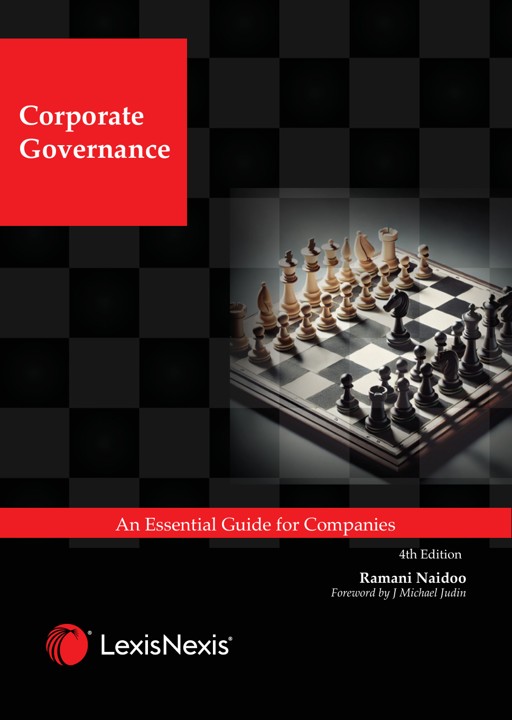
A world first: the AI Companion to the book Corporate Governance: An
Essential Guide — 4th Edition by
Ramani Naidoo.
The 4th edition examines governance across more than fourteen jurisdictions and
the new terrain of disruptive governance — AI, cybersecurity, digital
oversight and accountability — alongside the latest South African
developments, including King V and the 2025 JSE Listings Requirements.
Built on the book’s content and continually trained on leading global
frameworks and legislation, the Companion keeps the material alive long after
publication.
Virtual Board Members — a chair plus specialists in legal, ethics, remuneration, sustainability, digital and risk, each ready to be questioned.
Test your judgement — put a real dilemma to the board, hear it argued from several seats, and see which governance principles actually apply.
Interrogate the book — ask it directly, and get answers grounded in its content rather than in a general model’s recollection.
King and King V are trademarks of the Institute
of Directors in South Africa NPC (IoDSA), which owns the copyright in the
King V Code on Corporate Governance for South Africa, 2025. References on
this page and in the charter are cross-references for the reader’s convenience.
The Code itself is not reproduced and is available from the IoDSA at
iodsa.co.za.
JSE, SENS and AltX are marks of JSE Limited.
The charter is independent. It is not endorsed by, approved by, or affiliated with the
IoDSA or JSE Limited, and neither has reviewed it. No trademark rights are granted
by its licence.