Reciprocal reverse mentoring
- ArticleThe case for reciprocal learning · 3 pages
- Part AOrganisational policy · thirteen sections
- Part BMentoring pair relationship charter
Two PDFs, 10 pages · free with a short form
South African organisations may already employ some of the people who can help their leaders understand artificial intelligence. The challenge is to create a relationship in which practical knowledge of emerging technology can meet accumulated experience, with both participants able to learn and contribute openly.
Two PDFs, 10 pages · free with a short form
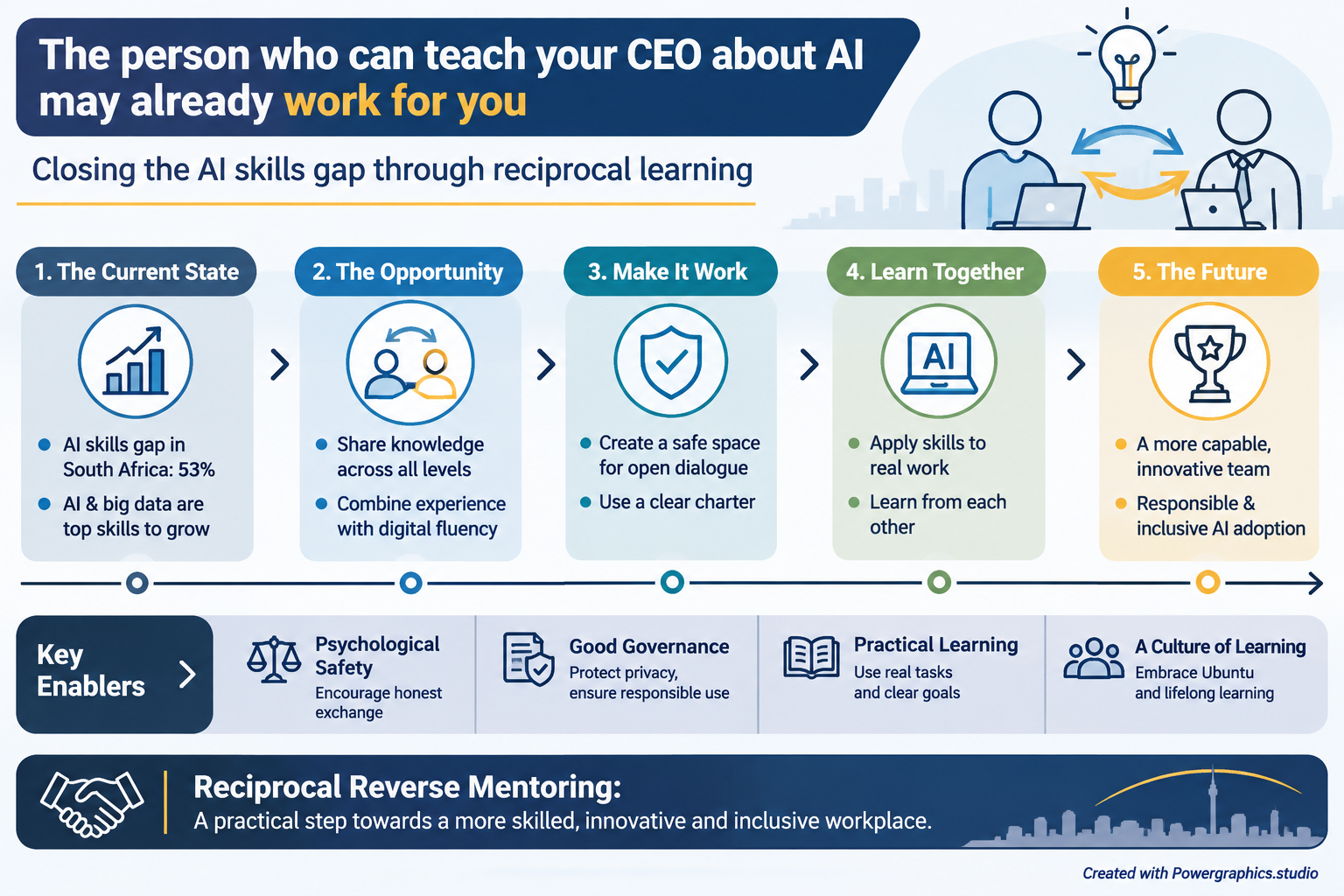
Closing the AI skills gap through reciprocal learning. The argument in the authors’ own words; the full article carries the reasoning and its sources.
A senior executive may bring decades of judgement, institutional memory and commercial understanding. A colleague several levels below them may have spent months exploring how generative AI can improve research, drafting or everyday work. Bringing those capabilities together offers a practical way to strengthen both people and the organisation.
This is why we use the term reciprocal reverse mentoring. Both participants contribute knowledge and both accept the discipline of learning. Age may be relevant to their different experiences, but it is a poor substitute for understanding their actual capabilities: digital fluency is not confined to the young, and sound judgement is not conferred automatically by seniority.
Consider an employee invited to challenge the AI assumptions of an executive who influences their remuneration or promotion. However warm the invitation, the employee may still calculate the career cost of disagreeing. The executive may feel a different pressure, wondering whether admitting uncertainty will undermine their authority.
A useful programme makes room for both concerns. Participants need permission to ask basic questions, disagree respectfully and admit mistakes, supported by a clear commitment against retaliation. Wherever practicable, pairing outside a direct reporting relationship can help, alongside an independent person to whom either participant can take a concern.
The person who helps your CEO understand AI may already work for you. Giving that person a voice, while giving both participants a chance to learn, is a practical step an organisation can take now. The accompanying framework sets out how to begin with clear objectives, appropriate safeguards and mutual respect.
The article makes the case. The charter turns it into arrangements an organisation can adopt and a mentoring pair can complete together.
Knowledge can move in both directions; candour needs protection; learning becomes useful when it meets a real task; responsible learning requires governance; the willingness to learn has a long history; and AI can give generations a reason to learn together. With sources and acknowledgements.
Thirteen sections: purpose and scope, principles and participation, programme oversight and matching, objectives and meetings, contributions and shared responsibilities, authority and accountability, confidentiality and permitted disclosure, privacy and records, AI tools and information security, respectful challenge and professional boundaries, concerns and ending an unsuitable pairing, feedback and measures of success and completion and policy review.
Complete this charter together before substantive sessions begin. Part A applies to this relationship, subject to the organisation’s approved adaptations and applicable law. The pair records what each offers and seeks, three to five learning objectives, meeting arrangements, contacts and safeguards, approved AI tools, records, and their shared commitment.
Both documents are free. We ask for your details so that we know who is reading them, and so we can tell you when we publish further research and guidance — if you want us to.
The charter is a model for adaptation: an organisation adopts Part A as its programme policy, and each mentoring pair completes Part B together.
We have also emailed you a confirmation.
Download the PDFThese links expire in 30 minutes.
Sharing the links will not work for long. Please send colleagues to this page instead so we know who is reading the documents.
Important
Adoption note This is a model for adaptation, not legal advice. Before adoption, the organisation should complete the fields, appoint the responsible people and align the framework with applicable law and its employment, privacy, AI, grievance, information security and records policies.
This charter records learning arrangements and does not itself amend employment terms, create delegated authority or waive statutory rights. Programme participation and feedback must be handled consistently with Part A.
The article provides general information and is not legal advice.